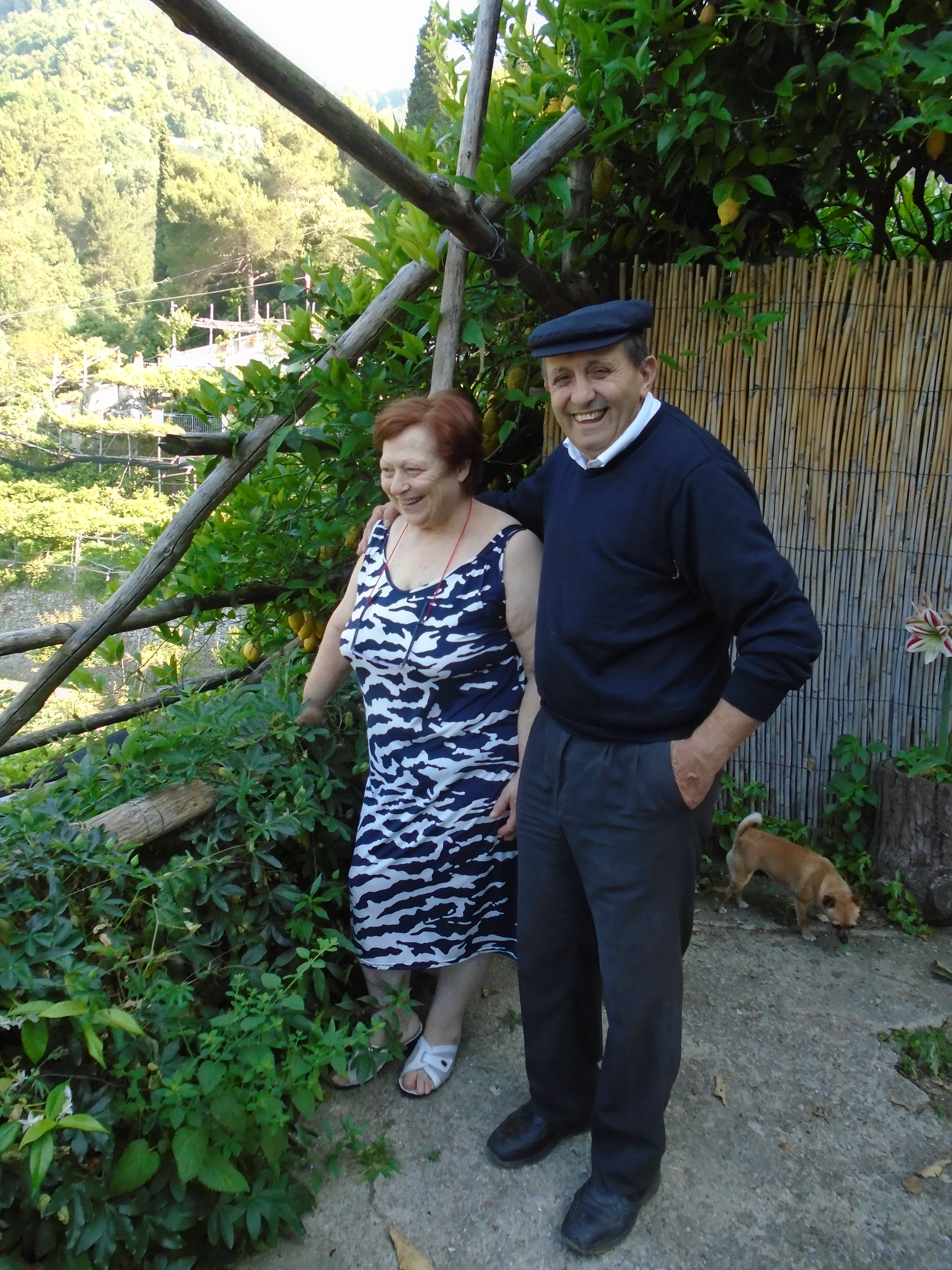
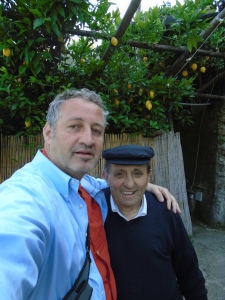
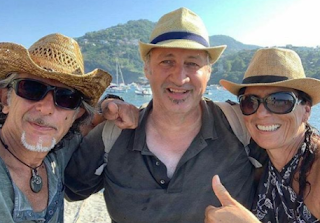
Me at My Favorite Restorante in Positano
Vino Vongole Pizza Pasta & Lemonade – Capri Positano The Amalfi Coast
Me at My Favorite Restorante in Positano
.
Provolone, always my favorite cheese when I was growing. It was my sister Barbara’s favorite as well and whenever we went to Barcelona’s Restaurant we always ordered a plate of Provolone along with Mussels Marinara, Baked Clams, and all our other favorites. Yes, Mozzarella was fine, but for my sister Barbara and I it just couldn’t keep up with the big bold flavor of Provolone.
I used to love walking into Belevedere Salumeria around the street from our house. The place had large torpedo-like Provolone (weighing 40-50 lbs.) hanging from the ceiling, along with Sopresseta, Prosciutto, and various types of Salumi. The smells dominated by the Provolone when you walked through the door were intoxicating. My friends and I, when we had a couple extra bucks we would treat ourselves and run over to Belevedere Italian Deli and get an awesome sandwich of Gabagool (Capicola), Salami, and Provolone, one of the world’s great sandwiches. Oh my God it’s making me hungry just thinking of it! I want one now!
So along with those boyhood memories of eating a piece of sharp Provolone off the antipasto platter or on one of those great Belvedere Sandwiches, I now have some more fond memories of Provolone Cheese. They come from my latest trip to Italy. I was down on the Amalfi Coast for the first time in a few years, and got a nice panino at a Salumeria one day. I was looking in the refrigerated glass case of Salumi and Cheese looking over their products. I decided on and ordered a panino made with Sopresseta and Provola Afumicata (Smoke Provolone). The counterman made my sandwich and when I ate that baby, boy the combination was absolutely amazing. I couldn’t believe it. I never had this combination before and I just loved it. Simple, just some Sweet Sopresseta and Smoked Provola, the combination was out of this world. It was simple, but each wonderful ingredient of perfectly cured Sopresseta Salami and wonderful Smoke Provolone on a nice Italian Roll, it just made for a great tasting sandwich. What more can I say? I ended up eating about 6 of those sandwiches from various salumerias on Capri, in Sorrento, and on the Amalfi Coast on that trip. I’d get a sandwich or an Arancini to hold me over between meals, if I was going to the beach or taking a boat ride from Amalfi to Capri, or whatever. The sandwiches were all so very tasty and an unexpected pleasure that I hadn’t expected at all. So now after eating all those tasty Panini I now I go to Faicco’s Pork Store around the block and buy some nice Sweet Sopresseta, Smoked Provola and get a loaf of Italian Bread, and I’m all set, right back there on Capri, eating my special Panino di Provola Affumicata e Sopresseta. This brings me back to Capri, Amalfi, and memories of a trip. A trip of beauty, tasty food, and recollections, the beauty of Capri and the Amalfi Coast, eating Vongole, Pasta, Arancini, and Provolone. I tell you folks, “it just doesn’t get much better than that.”
.
Now talking of these things, the Sopresseta, Provola, Capri Sorrento, and Napoli, I’ve got to bring up one more pleasure of that trip, the Aperol Spritz and Summer on the Amalfi Coast. It’s not that I’d never had an Aperol Spritz before. No, the first time I had one was way back in 1995 in Venice, the place where the Aperol Spritz was invented. I was on my exploratory trip of Venetian Wine Bars (Bacari) when I had my first Spritz. One evening I was walking around doing the Venetian Wine Bar tour. While walking on the Strada Nuova in Canareggio I dashed into a Bacaro I had spotted. I made my way up to the bar and surveyed the scene a moment before ordering. As I stood there I notice people drinking this particular drink. I asked the barman what they were drinking and he told me that it was a Spritz, “Prosecco with Aperol and soda.” OK, I said, “I’ll take one.” The barmen made me one in no-time flat, and that was my first Spritz, and I’ve had a number of them since then. Now getting back to that Summer 2015 on Costiera Amalfitana and the Aperol Spritz, they were everywhere, glasses of Aperol Spritz one after the other, bar after bar, caffe after caffe, table after table, everywhere you looked people were drinking this refreshing cocktail, the locals and tourists alike. Well I’d come back from the beach on my way back to my hotel, and as usual when on the Amalfi Coast when done at the beach for the day, I head to a nice bar or caffe for an Espresso, a glass of local White Wine, a Campari, or some other cocktail. Now all of a sudden it seemed that the Spritz had moved into high gear. The drink was quite popular, and as I’ve said, it was everywhere and everyone was drinking them. So I headed to the Piazza Umberto one day after a day at the beach (Faraglioni) as I usually do. There’s a few very popular caffe’s there, and it’s just a matter of picking one to spend your time at. I chose one of my favorites, the Bar Tiberius. I took a seat at a table outside and waited for the waiter to come over. The waiter came and I ordered an Aperol Spritz. He came back a few minutes later with a refreshing looking Spritz and a little bowl of peanuts for me to munch. Yes, it was good. My Aperol Spritz, Capri, the Piazza Umberto and all that goes with it, like a scene in a movie, set on the beautiful Isle of Capri. And you’re in it. Now that’s something.
So, I ended up drinking a good number of Aperol Spritz’s on that trip. I had them in Capri, Positano, in Sorrento, and at caffé in the piazza in Ravello. It’s a great drink that’s light and refreshing and a great way to start any evening, slow and easy, that’s the Aperol Spritz, it eases you into the evening with its lightness and refreshing taste. Enjoy one some time, I do.
So there you have it, the Provolone of my youth with those great Provolone & Gabagool Sandwiches at the Italian Deli Belveder, the Aperol Spritz, Capri, Napoli, Sorrento, and my Provola Panini on The Amalfi Coast. That’s Italy, Italian-America, Italian Food and memories of this blissful never-ending journey of Italian Food, the culture, people, places, and events. It’s all quite wonderful. Don’t you agree?
Excerpted from Daniel Bellino ‘s forthcoming book MANGIA ITALIANO …
PROCIDA GUIDE
PROCIDA
This volcanic island in the Gulf of Naples seems almost out of time, in the idyllic setting of fishing boats and small villages perched on hills.
Here a typically Mediterranean beauty and from literature to film it was starred in many works. In the late 1950s, Elsa Morante dedicated the book L’Isola di Arturo to this island.
Procida is the queen of slow tourism and should be discovered calmly, with no rush. It offers a perfect mix of natural beauty, glimpses of a long history and unmissable beaches. You can get around easily on foot, but buses or taxis are also available.
The territory of Procida is divided into nine contrade, called grancìe. These are Terra Murata (the oldest), Corricella (the fishing village), Sent’cò (with the commercial port of Marina Grande), Semmarezio, San Leonardo, Madonna della Libera (or Santissima Annunziata), Sant’Antuono, Sant’Antonio and Chiaiolella (a marina). At 16 kilometres in length, every corner is impressive, starting with the many small streets that open onto beaches hidden in bays.
The historic core is the hamlet of Terra Murata , which is in some ways its heart, but equally interesting is the small island of Vivara, connected to Procida by a bridge. Its peculiarity is that it is a protected natural island, which winks at a more informal tourism.
Procida can also be visited in one day, the most important thing is to plan your movements or, alternatively, to let yourself go by instinct or the tips of the locals.
To get there, take the ferry from the port of Naples or Pozzuoli, a one-hour boat ride. You will get to Marina Grande, the harbour and beating heart of the centre, divided between craft shops, bars, small boutiques and rental points for mopeds, bicycles, minicars and various boats.
From here you can move towards the historic centre, climbing up Via Principe Umberto to Piazza dei Martiri, passing by the Sanctuary of Santa Maria delle Grazie and stopping at the Belvedere dei Cannoni to observe Marina Corricella in all its wonder.
Terra Murata is the ancient historical centre. Here you can visit Palazzo D’Avalos, which used to be a palace and prison, and get lost among courtyards, stairways and small squares until you reach the 11th-century Abbey of San Michele Arcangelo. In addition, it boasts a museum complex on the three floors below.
The fishermen village, Corricella, is a place you can walk to. The small houses of different colours are reflected in the transparent waters of the marina and it is one of the most beautiful and characteristic views of the island.
.
.
The APEROL SPRITZ
The APEROL SPRITZ
“A Brief History”
Often described as an Italian sunset in a glass, the Aperol Spritz originated in the city of Padua and has become one of the most famous cocktails from Italy. The Aperol liqueur became a beloved apéritif in Padua and out of its rising popularity the Aperol Spritz was born during the chic 1950s in Northern Italy.
In 1919, Luigi and Silvio Barbieri created Padua’s famous Aperol and as this bitter apéritif rose to fame, so did experimentation. During the 1950s, Veneto was at the peak of chic fashion and gastronomic delicacies, allowing the optimum moment for the Aperol Spritz to enter Paduan society.
Spritz is a form of cocktail as opposed to a singular drink, the term originates from the German Spritzen. The origin of the Spritz dates back to the 19th-century when the Austro-Hungarian Empire’s owned the region. When Austro-Hungarian soldiers first tasted Italian wines, they found them too strong for their taste and subsequently spritzed their glasses with water to dilute the flavor.
The years leading up to the 1950s saw rigorous advertising of the Barbieris’ apéritif, resulting in Aperol taking over Campari in popularity. Following a TV advert displaying the Aperol Spritz’s recipe, the cocktail soon rose to fame as a luxe drink for lunchtime aperitivo and summer evenings. By early 2003, the Campari Group had purchased Aperol and marketed the Spritz as a cocktail for the trendy and fashionable members of Venetian society.
The beauty of the Aperol Spritz lies in the simplicity of its ingredients, which extracts the quality of each native component. The foundation of this cocktail is Aperol from Padua, with Veneto’s adored Prosecco and chilled soda. The Aperol’s vibrant orange hue is slightly diluted with sparkling wine, painting the Spritz with a softer sunset glow perfect for summer evenings.
HOW to Make an APEROL SPRITZ
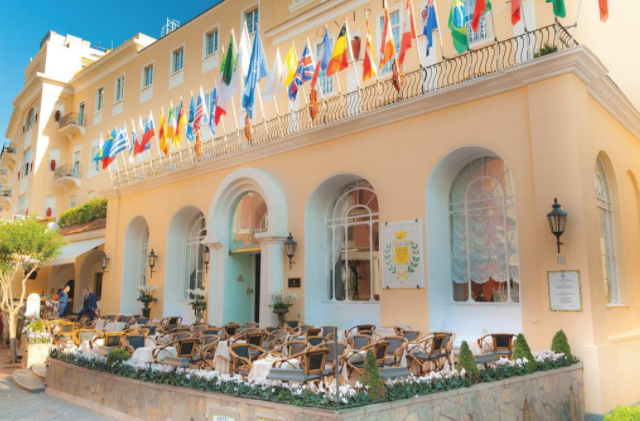
The GRAN QUISISANA HOTEL
CAPRI
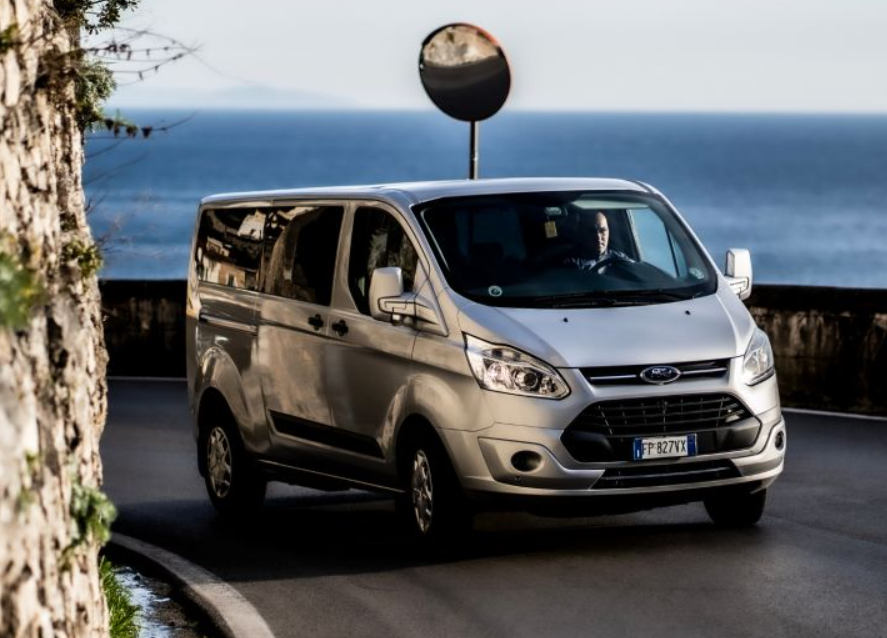
CAPRI TAXI
MARINA GRANDE
CAPRI
Immerse yourself in the breathtaking beauty of the Amalfi Coast as you cruise across its deep-blue waters. Enjoy a hotel transfer in Sorrento and discover the quaint towns of Positano and Amalfi on a full-day boat tour with prosecco, snacks, and a limoncello tasting included.
Start the day by being picked up from your hotel and arrive at the marina. After checking in, allow the staff to help you get to your boat and set sail toward Amalfi. Sit back and admire the coastline and, if the weather allows, enjoy a swim and photo stop.
Disembark in Amalfi and enjoy 1 hour and a half of free time. Receive information about the area from your guide and stroll around at your own pace to explore the sites of your choice. Once back on the boat, begin the journey to Positano for more free time on land.
After all your sightseeing, make your way back to the boat and sail toward another idyllic swimming location. Enjoy drinks and snacks on board as you navigate back to the marina. Before docking, taste some delicious homemade limoncello, then be helped toward the vehicle that will drive you back.
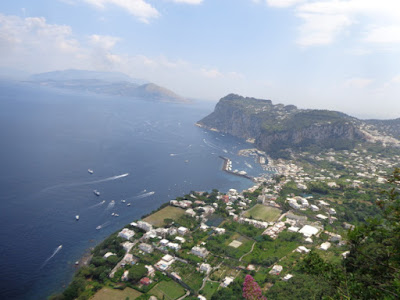
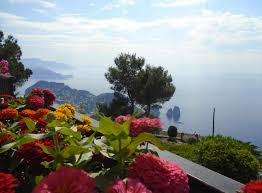
An island of rocky limestone, jagged coastline, and sandstone cliffs in the Gulf of Napoli, Capri has been a resort destination since the second century BC, when Roman emperors used it as a retreat and playground for what were rumored to be a wild slate of personal pleasures. Today, its natural wonders, medieval fortresses, rustic villas, posh shopping, and rugged coastline make it one of Italy’s most beloved travel destinations.
The center of social life on Capri is the popular Piazza Umberto I, “La Piazzetta,” which was once a fish market and now is one of the world’s most fashionable squares. It’s where locals and celebrities alike can be found sipping coffee or cocktails and people watching, surrounded by breathtaking views and architecture, including restored palaces, the Town Hall, and the famous Torre dell’Orologio, the clock tower that once was the bell tower of the Church of Santo Stefano.
In 1826, the re-discovery of the legendary Grotta Azzurra made Capri an even more desired destination. “The Blue Grotto” is a natural sea cavern and miracle of nature, where the water glows azure blue, illuminated by sunlight from an underwater cavity. Once feared to be the home of demons and spirits, it found new fame that drew artists, writers, and philosophers — including Maxim Gorky, Henry James, Pablo Neruda, and Friederich Nietzsche – to the island, along with millions of tourists from around the world.
Dining on Capri can be as simple as a picnic of caprese sandwiches on the beach, a late-night pizza along Via Tommaso de Tommasi, or an unforgettable meal of authentic, artfully prepared delights at one of the island’s Michelin-starred destination restaurants. You can enjoy flawlessly prepared fish and shellfish in restaurants set in a lemon grove or on a cliff overlooking the sea – the options are as rich and delightful as the island itself.
“There is no spot in the world with such delightful possibilities of repose as this little isle.”
English writer and social critic Charles Dickens (1812-1870), on Capri
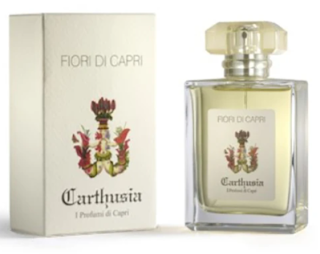
It’s fitting that an island famed for its beauty would give birth to one of Italy’s most iconic beauty brands: Carthusia.
Legend maintains that the father prior of the Carthusian Monastery of St. Giacomo on Capri was surprised by an unexpected visit from Queen Joanna I of Anjou in 1380. He scrambled to pick the most beautiful flowers on the island to present her in a bouquet. After the bouquet stood in a vase for three days, the water had taken on a haunting and beautiful fragrance – a scent of wild carnations that became the first perfume of Capri.
Whether there’s truth to this legend or not, in 1681, the monastery began distilling local flowers and herbs to create essential oils and fragrance blends. Those same, centuries-old formulas were rediscovered in the 1940s, and Carthusia uses them today to continue the tradition of limited-production, finely crafted, hand-produced fragrances of magnificent quality.
Here are three of Mozzafiato’s Carthusia favorites to bring the magic of Capri into your heart and home:


“Positano is never likely to attract the organdie-and-white linen tourist,” John Steinbeck predicted in Harper’s Bazaar in 1953. “It would be impossible to dress as a languid tourist-lady-crisp, cool white dress, sandals as white and light as little clouds, picture hat of arrogant nonsense, and one red rose held in a listless white-gloved pinky. I dare any dame to dress like this and climb the Positano stairs for a cocktail.”
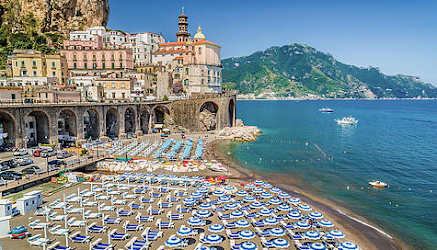
Steinbeck was spectacularly wrong. A decade after his article, the Rolling Stones wrote music in Positano and Jackie Kennedy vacationed in nearby Ravello. The Amalfi Coast comprises 34 miles and 13 towns on the Italy’s southern coast. Designated as a World Heritage Site in 1997, it quickly became a port of call for the subsection of rich people whose careers mainly entail broadcasting absurd luxury. For the sake of this article, I attempted to make an exhaustive list of celebrities who have vacationed in Amalfi, but it quickly became clear that even if I did this work until I died and left the task to my descendants, it could never be completed.
During the last two years, Google searches for “Positano” have spiked as dramatically as the cliffs into which the town is set. #AmalfiCoast has more than 330 million views on TikTok. “Everyone is on the Amalfi Coast right now,” comedian Kate Berlant reflected in her podcast Poog. “There it is—the poison of Instagram!” her cohost, comedian Jacqueline Novak, responded. “You’re walking around with this idea that everyone is on the Amalfi Coast right now?” And yet—this is how it feels.
A local Amalfi news site notes that this summer, tourism on the coast looks likely to break previous records—this despite the fact that the area usually enjoys high tourism numbers from Russia, whose citizens won’t be traveling this summer. The article credits social media for the boost. U.S. News and World Report ranked Amalfi number one in “Best Beaches in Italy,” number two in “Best Honeymoon Destinations in Europe,” and number 3 in “Best Places to Visit in Italy.” Brides magazine put it first in a list of romantic places to honeymoon. In March, Rebecca Serle released the book One Summer in Italy, set in Positano. It sailed onto the best-seller list like a catamaran on a breezy day.
Popularity has a price. All roads lead to Rome, but only one road leads to the Amalfi Coast. This means that travel during high tourist season is less “laughing merrily in your convertible” and more “hours-long gridlock nightmare as you scrounge in your tote bag for loose cashews.” A rule imposed this summer by the Italian government dictates that all throughout August and every weekend from June 15 to September 30, visitors to the area may only travel on the roads on odd- or even-numbered days, depending on the last digit on their license plate, CNN reports. The Italian economy suffered from the lack of tourism in 2020, during the height of the pre-vaccine pandemic. The influx of visitors since the country reopened to tourists is a mixed blessing.
The average price of a hotel room in Positano has increased more than 20% since 2019, Bloomberg reports (it’s now a sweet, sweet $618.38.) Airline prices are at historic highs. So how, exactly, is everyone on my timeline affording this vacation?
Many visitors are likely funding their spectacular vacations not through largesse, but debt. A 2019 survey from Credit Karma found that about a third of all travelers and half of all millennial and Gen Z respondents said they had gone into debt for summer travel (the majority reported that they would be “willing to do it again.”) A survey from Allianz found that this year Americans plan to spend $2,122, on average, for vacation, a 50% increase from 2019. Despite the reports that air travel this summer has been and will continue to be “hell,” the last Sunday in June saw more travelers than any day since February 2020, a TSA spokesperson reported. At a dinner party recently, a woman mentioned in a world-weary way that she has visited Positano three times. She sounded exhausted, as if instead of the Italian coastline, friends and bachelorette parties had dragged her to Trenton, New Jersey.
For so many years I did not think about the Amalfi Coast—I thought about Paris and London and Bora Bora, and when I thought about Italy, I thought of Rome and Venice and Milan and Tuscany. Sometimes I thought about Pisa, Pompei, Florence, and Siena. Later I thought about whatever area Call Me By Your Name was shot. I cannot believe there is another part of Italy I am supposed to be thinking about. And yet. “Positano bites deep. It is a dream place that isn’t quite real when you are there and becomes beckoningly real after you have gone,” wrote Steinbeck. Or in the words of a Glamour staffer who visited once for six hours: “I follow every account and look at the webcam of Positano every night before I go to bed because it calms me.”
Through a proliferation of images the novelist could never have imagined, the Amalfi Coast has amassed real estate in hundreds of millions of minds. If everyone on the Amalfi Coast jumped off a cliff—into sparkling sapphire waters—would you? Yes, of course. As long as someone was taking a picture.
INGREDIENTS :
Sunday Sauce